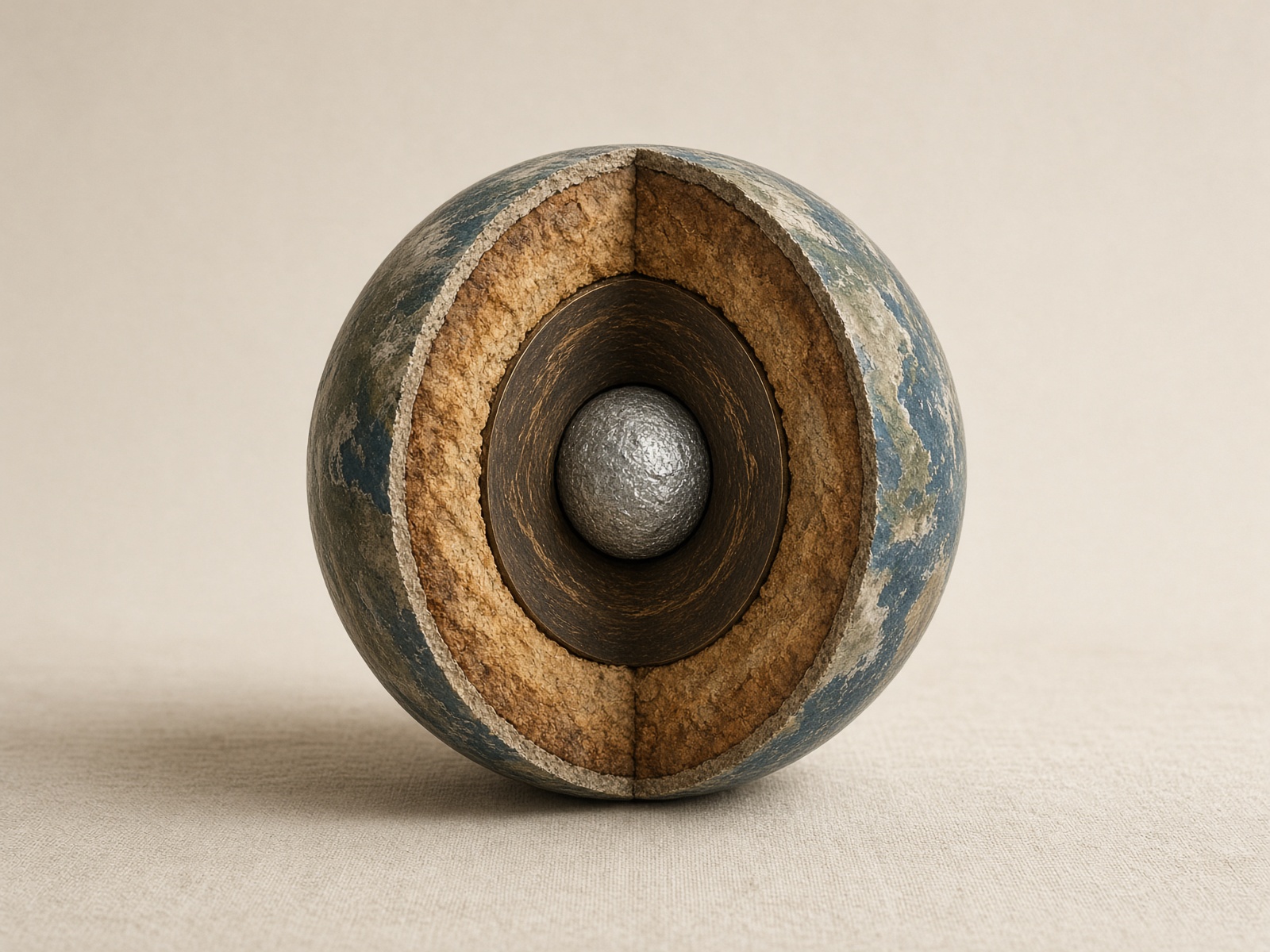
Four main layers
Crust: thin, rocky outer skin. Mantle: thick rocky layer beneath the crust. Outer core: liquid iron and nickel. Inner core: solid iron and nickel at the center. Temperature and pressure both increase with depth.
Solid inside a liquid
The inner core is solid material and the outer core is liquid material. The inner core is hotter, but the pressure is so high the metal cannot melt. Moving liquid metal in the outer core is what powers Earth's magnetic field.
Earthquake waves as a flashlight
We cannot drill to the core. Earthquake waves travel through Earth at different speeds in different materials. S waves will not go through liquid — they vanish at the outer core — which is how scientists mapped a liquid layer around a solid center.
Describe the crust
The crust is thin and rocky. Continental crust (the land) is thicker and less dense. Oceanic crust is thinner and denser, which is why oceans sit in those lower basins.